Dragon fruit e-liquid, mixing it yourself at the right rate

Dragon fruit has a misleading reputation. Its striking flesh suggests a bold taste, yet the white-fleshed pitaya is a gentle fruit, often compared to a kiwi without the sharpness. For a homemade dragon fruit e-liquid, that gentleness changes everything. Too little concentrate gives a flat bottle, too much buries the fruit under a synthetic note. And concentrate makers do not all publish the same rate.
Dragon fruit e-liquid at home, the starting rate
A concentrate is a highly loaded flavouring, sold to be diluted in a base of propylene glycol (PG) and vegetable glycerine (VG). For a single-flavour dragon fruit concentrate, the starting point published by the French maker Arômes et Liquides is 5 per cent in a 50/50 base, with 2 to 3 days of steeping. In 60 ml of dragon fruit e-liquid, that comes to 3 ml of concentrate.
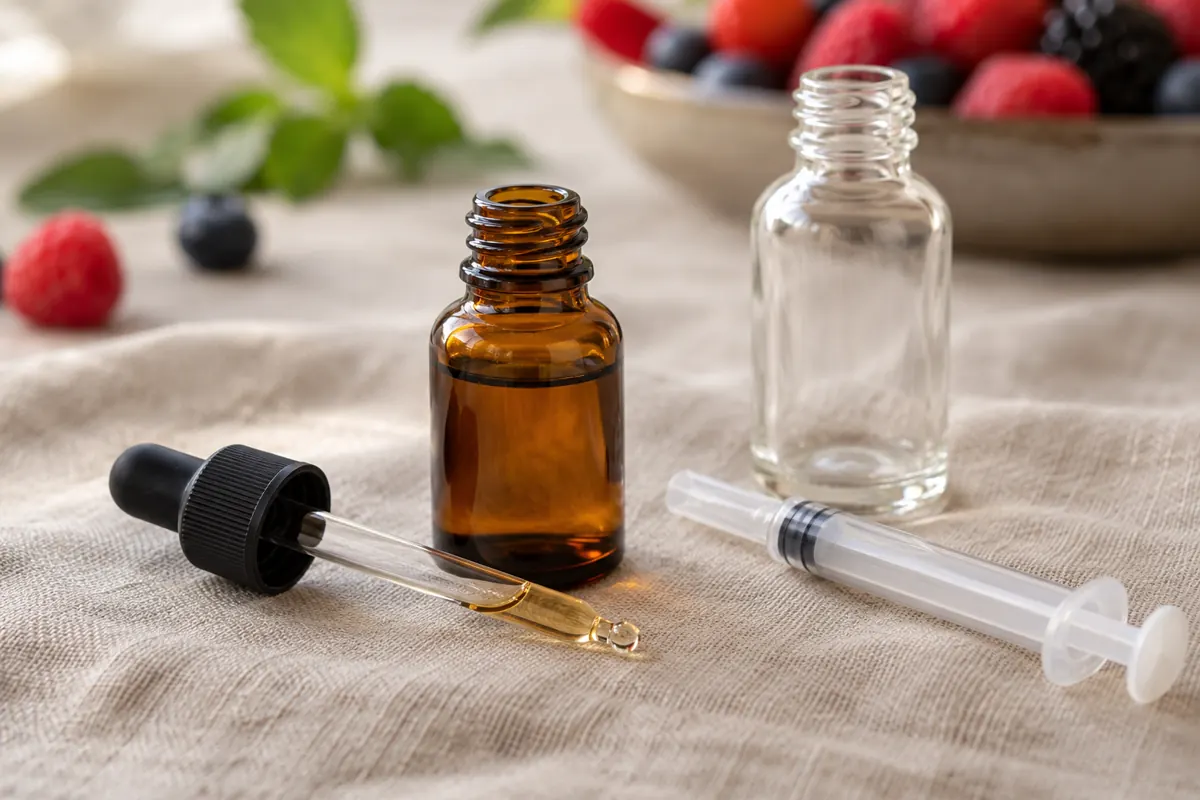
This single flavour comes in a 10 ml bottle, made in France and carried in propylene glycol. Its product page states that it must not be used neat and converts the rate into drops, 25 drops per 10 ml of mix. That conversion is fragile, since drop size depends on the dropper tip. A graduated syringe, or the scales, measures more accurately once a recipe goes beyond 10 ml.
Why rates vary so much between concentrates
A percentage only means something when tied to a specific bottle. Two concentrates carrying the same fruit name can call for very different rates, depending on their strength and make-up.
Single flavours, one taste at a low rate
Revolute’s dragon fruit also comes in a 10 ml bottle made in France. Yet two retailers do not publish the same rate for it, 5 per cent at one, 10 per cent on the other’s product page. Faced with that gap, the rule is simple, start from the lower figure and only go higher after steeping, the resting time during which the flavour blends into the base.
One-shot concentrates, a recipe already assembled
A one-shot concentrate already combines several flavours, here dragon fruit with other fruits, in a recipe ready to dilute. On one retailer’s page grouping around twenty of them, the listed rates run from 5 to 20 per cent. A one-shot is therefore never mixed at a single flavour’s rate, and its own product page outranks any habit picked up with another bottle.
How much mix one bottle of concentrate makes
The rate also decides how much liquid a single bottle yields. The reverse calculation is one division, the bottle volume divided by the target rate.
| Concentrate rate | Mix from a 10 ml bottle |
|---|---|
| 5 per cent | 200 ml |
| 10 per cent | 100 ml |
| 15 per cent | about 66 ml |
| 20 per cent | 50 ml |
A single flavour used at 5 per cent therefore yields four times as much mix as a one-shot used at 20 per cent. That ratio matters when choosing between a recipe you build yourself and one that comes ready assembled.
A worked 60 ml dragon fruit e-liquid recipe
Take 60 ml at 3 mg/ml of nicotine, with the single flavour at 5 per cent, an 18 mg/ml 50/50 nicotine shot and a 50/50 base. In the UK, nicotine liquid is capped at 20 mg/ml and sold in bottles of 10 ml or less, which is why shots come in that size. The shot volume follows the formula used across this site, target strength multiplied by final volume and divided by shot strength, so 3 × 60 ÷ 18 = 10 ml, exactly one shot.
For this dragon fruit e-liquid, the concentrate takes 3 ml and the base fills the bottle, 60 − 3 − 10 = 47 ml. To check the strength, 10 ml × 18 mg/ml gives 180 mg of nicotine across 60 ml, or 3 mg/ml.
By weight, with the density of about 1.15 g/ml used across this site for 50/50 base and shots, you need 11.5 g of shot and 54.05 g of base. Measure the concentrate by syringe. Our guide to the DIY e-liquid workstation sets out the full weighing method, from workstation to label.
Which base suits a homemade dragon fruit e-liquid
The final ratio cannot be read off the base label. The concentrate and the shot bring their own carrier liquid, and it is the total that reaches the coil.
The final ratio of the recipe
In the 60 ml recipe, propylene glycol comes from three sources, 3 ml of concentrate, 5 ml from the shot and 23.5 ml from the base. The total reaches 31.5 ml out of 60, a finished mix of 52.5/47.5 PG/VG. At such a low rate, the concentrate barely moves the ratio, unlike a one-shot used at 20 per cent.
A light flavour against vegetable glycerine
Vegetable glycerine softens how flavours come across. In a dragon fruit e-liquid, where the fruit is already gentle, a VG-heavy base risks wiping out what is left of the pitaya. A 50/50 base keeps the fruit readable, moving to a 30/70 base only if your kit calls for it. Our guide to choosing a VG/PG base covers the bases on sale in more detail.
Pairing dragon fruit without drowning it
In the names of the ready-made e-liquids found for this flavour, dragon fruit sits next to strawberry, red berries, cherry, nectarine, peach or lychee. It acts as a rounded, sweet background, while the second fruit brings the sharpness it lacks.
In DIY, each added flavour stacks on top of the first. With a second single flavour also used at 5 per cent according to its own page, the 60 ml recipe moves to 6 ml of concentrate in total, and the base drops to 44 ml. Propylene glycol then rises to 33 ml, a finished mix of 55/45. Write both percentages on the label, or the recipe cannot be repeated.
A partner that is too strong remains the main trap. A sharp flavour used at the same rate as the dragon fruit can take over completely. It is better to lower it by one point, keep the dragon fruit at its reference rate, then compare after steeping.
Steeping and adjusting after the rest
The 2 to 3 days of steeping given for the single flavour are not a formality. A gentle fruit tasted on mixing day often seems weaker than it is, and the urge to add more concentrate comes too early.
If the fruit is still faint on the third day, adjust in steps of one point, from 5 to 6 per cent, in a fresh batch rather than in the steeped bottle. In 60 ml, one extra point means 0.6 ml of concentrate, an amount only a fine syringe measures properly. The new rate then goes into your notebook, with the date and the base used.
FAQ
The questions that come up around this flavour, beyond the rate, the base and the recipe.
Are pitaya and dragon fruit the same concentrate?
Pitaya is the other name for dragon fruit, and makers use either one on their bottles. A concentrate labelled pitaya reads as dragon fruit, as long as its product page confirms whether it is a single flavour or a one-shot.
Why does dragon fruit seem to lack taste?
Because the most common variety, with white flesh, has a light flavour. Red-fleshed pitaya is known for a stronger, sweeter taste. A concentrate’s description often says which profile it aims for, a useful clue before choosing one.
Does a dragon fruit concentrate contain nicotine?
No, a concentrate only brings the flavour and its carrier liquid. Nicotine comes solely from the shot, freebase or nic salt, and our guide to nic salt shots in DIY works through that calculation.
What should a dragon fruit concentrate smell like?
Neat, a concentrate smells far stronger than the finished mix, and its scent says little about the taste once diluted. The only useful sign from the bottle is a clear change in smell or colour over time, which should keep the concentrate out of any new recipe.
How do you make an iced version at home?
With a cooling additive sold for DIY, used at the rate its maker gives. Its percentage adds to the flavours, so the base has to be recalculated to keep the final volume and nicotine strength.
Dragon fruit e-liquid mixed with method
A single flavour at 5 per cent, a 50/50 base that keeps the fruit readable, 2 to 3 days of steeping and adjustments in one-point steps are enough for a successful first batch. Beyond that, the product page of the chosen concentrate alone sets the right rate.
A homemade dragon fruit e-liquid works when you respect the fruit’s gentleness instead of fighting it with a higher rate. Reading product pages this carefully pays off with every exotic fruit you mix yourself.
From the same recipe book
- Red Astaire concentrate, the maker’s rate in a worked DIY recipe
- VG/PG base, choosing 50/50, 30/70 or max VG for the recipe
- DIY e-liquid workstation, set up clean and mix by weight
Editorial guide for adult readers only. Vaping products can contain nicotine, which is addictive, and vaping products are not for sale to anyone under 18 in the UK. This guide describes a mixing method and is not a buying recommendation.